Industries8 min read
Customer service for energy, water and city networks with AI
AI can relieve customer service at electricity, water and city network companies by explaining invoices, moving routines, default contracts and the rules on outage compensation. The answers must separate grid and supply and follow the rules of the Swedish Energy Markets Inspectorate. Current service status and details about a specific customer must come from the right system, not from the knowledge base.
 Rickard CollanderFounder, Supportifier
- Published
- Updated
Electricity companies, water utilities and city networks can use AI to explain invoices, moving, contract types and the rules for power outages. The answers must keep grid and supply apart, and current service updates must come from a live operational source, not from previous tickets.
Topic overview. Illustration, not a product interface.
Why must customer service separate the grid from electricity supply?
Because the customer has two different contracts with different rules. In Sweden, the grid contract is signed with the company that owns the network where the customer lives. According to the Swedish Consumers' Energy Markets Bureau, the grid company cannot be chosen, while the electricity supplier can. A question about the "electricity bill" can therefore concern either company.
The same goes for city networks. A customer who writes that the internet is down may have a question about the network, their service provider or the equipment at home. The knowledge needs to state who is responsible for what, and the AI needs to be able to ask a short follow-up question instead of giving a long general answer.
What applies to power outages and outage compensation?
The customer is entitled to outage compensation if the outage lasts at least 12 hours in a row. According to the Swedish Energy Markets Inspectorate (Ei), the compensation is 12.5 percent of the customer's estimated annual grid cost, but at least 2 percent of the Swedish price base amount. The customer must make a claim within 2 years.
The compensation increases by 25 percent of the annual grid cost for each further 24-hour period begun, and can be at most 300 percent. An outage counts as over only when power has worked for at least 2 hours. According to Ei, power outages longer than 24 hours are prohibited, and the customer should then report it to Ei.
These are rules that fit in a reviewed help article. Whether an outage is happening right now, or whether this particular customer is entitled to compensation, requires data from the grid company's own systems.
Which questions does an energy company get most, and who should answer?
The table shows typical examples of questions and where they can be handled. It is not statistics from any company, but a way to sort your own questions.
| Typical question | Channel and knowledge | Needs an extra check |
|---|---|---|
| Why have I been given an expensive default electricity price? | Help centre on default contracts | The customer's contract history |
| How do I report a move? | AI form with a reviewed routine | Contract and metering point |
| What do the lines on the invoice mean? | Help centre with explanations of terms | The individual invoice |
| Is there a power cut where I live? | Referral to an approved service-status source | Current service status |
| Will I get compensation for the outage? | Help centre with Ei's rules | Length of the outage and the customer's grid cost |
| Who helps me with my broadband? | AI chat explaining who is responsible | Address and chosen service provider |
| Why has the water charge changed? | Help centre on the tariff | The customer's consumption |
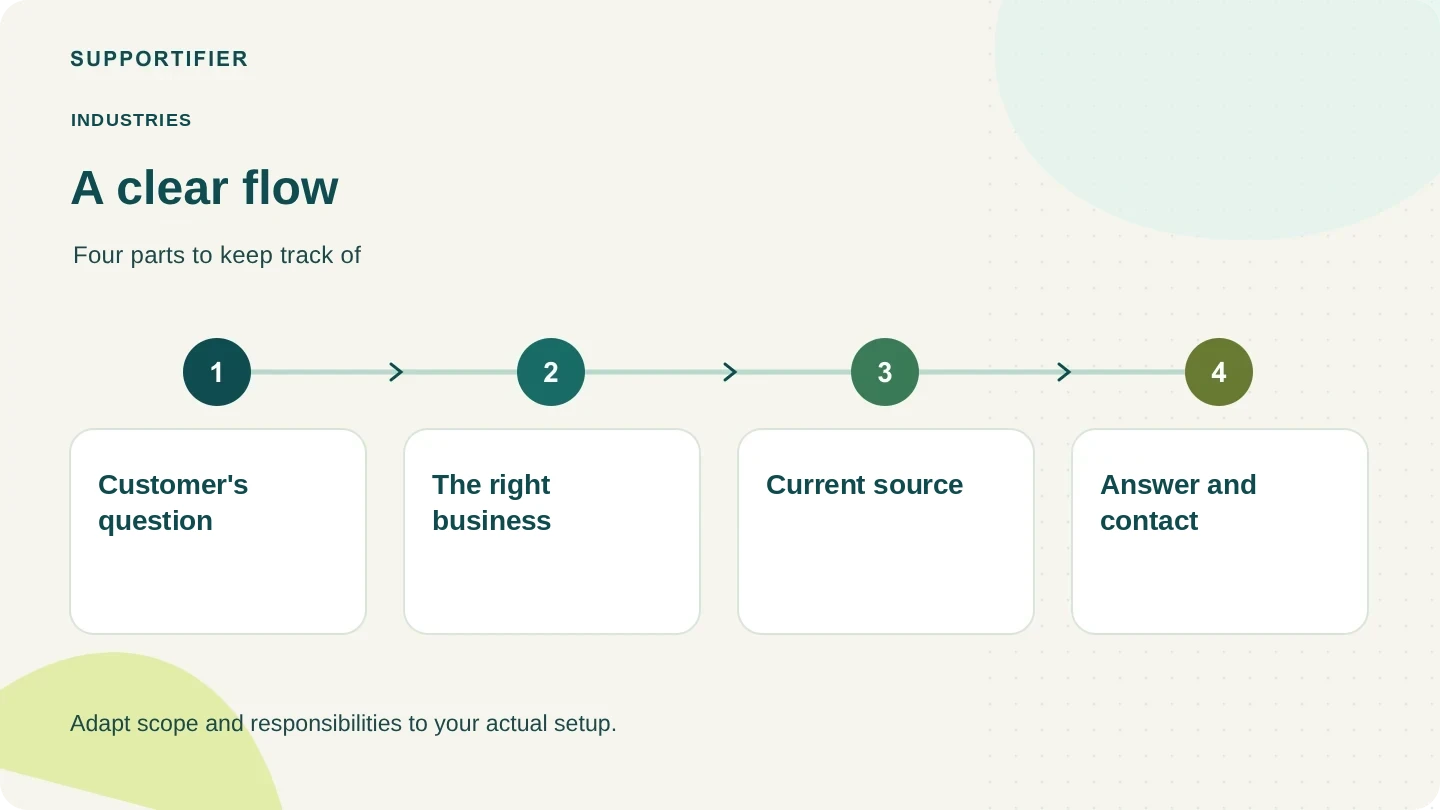
A suggested workflow. Scope and responsibilities are adapted during onboarding.
How do you explain default contracts and moving without giving wrong answers?
By writing the rules down once and having someone responsible review them. According to the Swedish Consumers' Energy Markets Bureau, the grid company must assign an electricity supplier if the customer has no contract, for example when moving in. The notice period for an assigned contract may not be longer than 14 days.
Assigned prices are often higher than other options, which is why the question often comes after the first invoice. A good answer explains why the contract arose, that it can be terminated at short notice and how the customer chooses a contract of their own. It should not guess what price the customer pays.
With fixed-term contracts, an early termination fee may apply if the customer ends the contract early. That rule depends on the contract and therefore belongs to the questions that need a check.
Moving is a good first flow because the question is common and the routine is clear. The customer needs to know that the grid contract follows the address, that a supply contract of their own should be signed well before moving in, and what happens if there is no contract. An AI form can collect the moving date, address and metering point so the case officer does not have to ask for them afterwards. Telephone sales is another topic where the customer may need a reviewed answer, since a contract entered into when the company called must be confirmed in writing.
Why should old outage notices not be used as live information?
Historical tickets can provide material for a guide on how the customer should act during an outage. They cannot show whether a disruption is happening right now. Decide which source is authoritative for service information and what happens when it cannot be read.
If current status is missing, the customer should be told so and referred to your service information or contact. The AI should not fill the gap with a likely answer. Measure invoice questions, moving and service questions separately, since a storm or a price change creates peaks that cannot be compared with a normal week.
How to start with Supportifier
Start from the most common questions about the invoice, default contracts or moving. Supportifier can gather and structure existing material while you review what is current. The shared knowledge is then used in the channels you choose, such as the help centre, AI form and inbox.
Needs for meter readings, contracts or service data should be described as separate connections. Supportifier's integrations page shows the published offering and does not promise ready-made connections to every energy and water system.
What does Supportifier cost for an energy company? A worked example
Supportifier is priced by tickets per month, not per user. An example: an electricity company gets 1,700 tickets in a normal month and 2,300 in a month with storms and many outages.
| Example | Per month | Per year with yearly billing |
|---|---|---|
| Scale, 2,000 tickets per month | USD 549 | USD 5,929 |
| Storm month: 300 tickets above the volume | +USD 120 | charged the following month |
A normal month fits in Scale. The storm month costs 549 + 3 × 40 = USD 669. That is cheaper than staying on Pro all year to cover a few peaks.
Prices exclude VAT and are taken from the pricing page in November 2026. Every channel, every AI agent and unlimited users are included in each plan, so the price does not change when more people on the team answer. Above the plan's volume it costs USD 40 per 100 tickets started, and you can change plan at any time. The volume in the example is chosen to show the calculation, not statistics from any company; calculate with your own figures.
Common questions
Can AI say whether an outage is under way?
Only with a current service-status source and a scoped flow. A knowledge base with previous tickets does not show today's status. Without such a source, the AI can explain the rules for outage compensation and refer to your service information, but not confirm whether there is an outage at the customer's address.
Can AI calculate the customer's outage compensation?
It can explain Ei's rules: an outage of at least 12 hours, 12.5 percent of the annual grid cost and at least 2 percent of the price base amount. The amount itself depends on the customer's grid cost and the length of the outage, and that answer should come from the grid company.
Can the same solution be used for supply and grid?
The knowledge can be gathered in one platform, but rules, responsibilities and contact routes must be kept clearly apart. State in every answer which business it applies to, especially in groups where the same customer has both a grid and a supply contract.
Are there ready-made integrations with every energy system?
No, the published list of integrations does not support that. A necessary connection to, for example, a customer system or meter data is investigated based on your system and needs.
Next step
Want to try it yourselves first? Start 7 days free, no card needed. Would you rather walk through a first flow with us: bring a recurring question, where the answer lives today and which systems the team uses. Book a walkthrough.
Read more
- AI customer service for telecoms: better first-line fixes
- Manufacturer customer service: AI support in the aftermarket
- Housing company customer service: AI that helps tenants
- 7 customer service metrics you can actually act on
Sources
- Energimarknadsinspektionen: Elavbrott
- Konsumenternas energimarknadsbyrå: Ska du flytta eller teckna ett nytt elavtal?
- Konsumenternas energimarknadsbyrå: Om du inte väljer elavtal
Rules and product details checked on 9 October 2026. This page is general information, not legal advice.
This page is also available in Swedish: Kundtjänst för elbolag, VA och stadsnät: AI med rätt underlag