Industries7 min read
AI customer service in banking and insurance, reviewed
AI customer service in banking and insurance can explain routines, show how a claim or a complaint works and refer to the complaints officer. General information must be kept apart from advice, claims decisions and account details. A sensible first step is reviewed reply suggestions or public service information, after the organisation's own assessment of its requirements.
 Rickard CollanderFounder, Supportifier
- Published
- Updated
Banks and insurers can use AI to explain routines, show the way to claims and complaints and give the team reviewed reply suggestions. Assessments of compensation, credit or advice should stay with authorised staff.
Topic overview. Illustrative image, not a product interface.
Which questions does a bank or insurer get most often?
Payments, fraud and loans are large question areas. The Swedish Consumers' Banking and Finance Bureau registered just over 9,300 cases in 2023. Payments accounted for just under 4,100, loans for around 2,000 and savings for almost 1,200. Complaints about unauthorised transactions and fraud rose by around 30 percent compared with 2022.
These are figures from a consumer guidance service, not from a single company's customer service. They still show which questions are often difficult for the customer. The Bureau also noted that complaints linked to anti-money-laundering rules made up around a quarter of all complaints, which shows how important it is to explain why the bank asks know-your-customer questions.
The table below shows typical example questions and suitable handling. It is not based on data from any company.
| Typical question | Channel and knowledge | Requires authorised handling |
|---|---|---|
| How do I report a claim? | Help centre with process and documents needed | Cover, amount and claims decision |
| I have been scammed, what do I do? | Clear referral to blocking and the fraud contact | Investigation of the transactions |
| Why are you asking where my money comes from? | Help centre on know-your-customer rules | The customer's own case |
| How do I complain about a decision? | Help centre with the complaints routine | Review by the complaints officer |
| What does excess mean? | Approved explanation of the term | The terms of the customer's policy |
| Which savings product suits me? | Referral to advice | Personal advice |
| Where is my case? | Contact route or signed-in channel | Authorised access to the case |
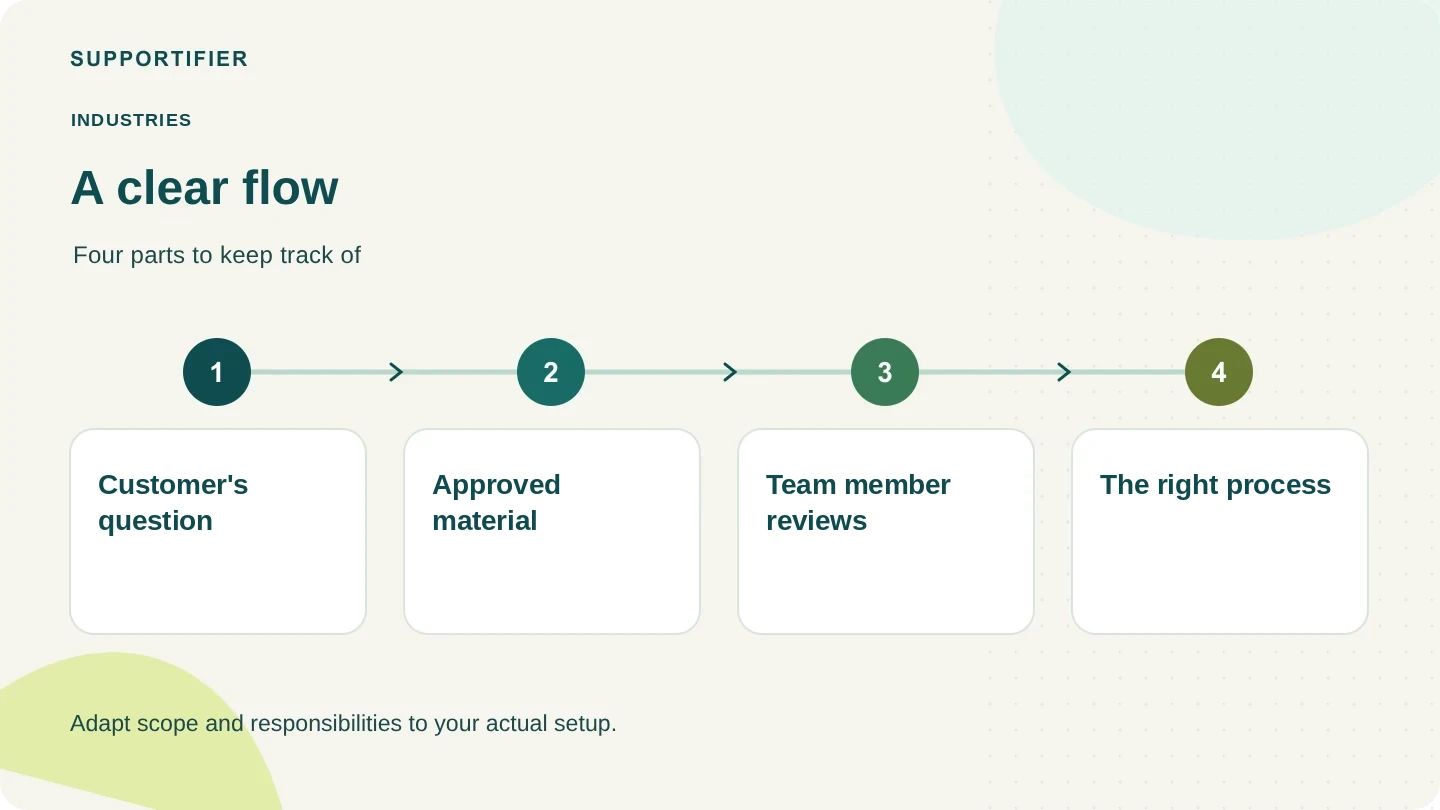
A suggested workflow. Scope and responsibilities are adapted during onboarding.
How should AI refer a complaint?
To the company's complaints officer, in the first instance. Finansinspektionen, the Swedish financial supervisory authority, writes that it cannot intervene in individual cases. The customer should first turn to the company's complaints officer, then to the National Board for Consumer Disputes (ARN) and, as a last resort, to a general court.
For insurance matters, Konsumenternas gives more detail. An insurer should normally answer a complaint within 14 days or explain the delay. The customer generally has six months from the case handler's decision to ask for a review. A complaint to ARN should normally be made within a year of the first complaint, the fee is SEK 150 and the amount in dispute must exceed SEK 3,000.
AI customer service can explain this process and link to the right form. It should not decide whether the complaint is justified. The customer should also be able to be referred to the independent bureaus: the Swedish Consumers' Banking and Finance Bureau and the Swedish Consumers' Insurance Bureau.
Where is the line between service and advice?
The line is where the answer depends on the customer's finances, terms or case. Explaining how a claim works is different from promising compensation. Describing an account service is different from recommending which option the customer should choose. Write those limits into the knowledge and test that they hold.
Fraud questions are a category of their own. When a customer writes that they have been scammed, the answer should quickly lead to blocking and the right contact, not to a long explanation. Test such questions with everyday wording, because the customer often does not use the word fraud.
Why are reviewed drafts a good first step?
Because a team member checks every answer before it is sent. The AI can put together a draft and show the material behind it, while the team is responsible for what may be communicated. That suits an organisation where incorrect information can have financial consequences.
Supportifier describes an inbox with AI reply suggestions that are reviewed before they are sent. According to Supportifier's security page, customer data is stored within the EU/EEA and customers' tickets are not used to train AI models. That is input for your own review, not a statement that the platform suits every regulated process. Requirements on contracts, security, access, traceability and outsourcing need to be worked through before a decision.
How do you test that the AI keeps to the limits?
By testing the exceptions, not just the standard answer. Use questions where the customer mixes up products, lacks a term or asks the AI to confirm a conclusion that is not in the material. Check that the system refers onwards when it needs more than general service knowledge.
Build the test questions from real ticket types. Include a customer who wants to know whether a claim is covered, a customer who believes they have been defrauded but does not say so directly, and a customer who is unhappy with a decision and wants to know the next step. The last case should always lead to the complaints routine, with the right time limits.
Follow the quality of a sample of answers and document which questions must not be handled automatically. Measure the time saved in the team together with corrections and repeat contacts. That gives a better basis for decisions than counting how many drafts were created.
What does Supportifier cost for banking, fintech and insurance? A worked example
Supportifier is priced by the number of tickets per month, not per user. An example: an insurer or a fintech gets 3,000 service tickets a month.
| Example | Per month | Per year with yearly billing |
|---|---|---|
| Scale, 2,000 tickets per month | USD 549 | USD 5,929 |
| 1,000 tickets over the volume | +USD 400 | charged the following month |
With 3,000 tickets, Scale plus overage comes to USD 949 a month, less than Pro at USD 1,299. Pro only becomes cheaper above roughly 3,800 tickets a month. Connections to core systems, or invoicing instead of card payment, are quoted as Enterprise.
Prices exclude VAT and are taken from the pricing page in November 2026. Every channel, every AI agent and unlimited users are included in each plan, so the price does not change when more of the team need to answer. Above the plan's volume it costs USD 40 per 100 tickets started, and you can change plan at any time. The volume in the example is chosen to show the calculation, not statistics from any company; calculate with your own figures.
Common questions
Can AI decide whether a claim should be paid?
No, not in the use case described here. Claims decisions require an assessment of terms, documents and circumstances. AI can explain the process, which documents are usually needed and how the customer asks the company for a review.
Can we start with internal reply suggestions?
Yes, reviewed drafts in the inbox are a bounded way of working where a team member always approves the answer. Suitability, material and the organisation's requirements still need to be assessed before onboarding.
Where should the customer turn if they are not satisfied?
First to the company's complaints officer, then to ARN or another board and, as a last resort, to a court. The Swedish Consumers' bureaus give free guidance. Finansinspektionen does not handle individual cases.
Is Supportifier approved for all regulated financial flows?
The published product information does not support such a general claim. Assess the specific flow against your requirements, including rules on outsourcing and information security.
Next step
Want to try it yourselves first? Start 7 days free, no card needed. Would you rather go through a first flow with us: bring a recurring question, where the answer lives today and which systems the team uses. Book a walkthrough.
Read more
- Escalation in customer service: when, to whom, how fast
- Why reviewed AI drafts beat full automation at the start
- 7 customer service metrics you can actually act on
Sources
- Finansinspektionen: Tipsa FI
- Konsumenternas: Klaga i ett försäkringsärende
- Swedish Consumers' Banking and Finance Bureau: Annual report 2023 (pdf)
Rules and product information checked on 9 October 2026. This page is general information, not legal advice.
This page is also available in Swedish: AI-kundtjänst för bank och försäkring: börja med granskad service