Industries8 min read
Housing company customer service: AI that helps tenants
AI in a housing company's customer service can explain how fault reports, notice and subletting work and show the way to the right contact. The answers must follow Swedish tenancy law and the company's own routines. Personal answers about rent, contracts or an open case require identification and system access, and urgent faults must always go to the on-call service or property management.
 Rickard CollanderFounder, Supportifier
- Published
- Updated
A housing company can let AI answer recurring questions about fault reports, notice, subletting and house rules, as long as the answers are based on reviewed knowledge and follow Swedish tenancy law. Questions about an individual tenant's contract, balance or case require identification and the right system access.
Topic overview. Illustration, not a product interface.
Which rules govern the answers in a housing company's customer service?
The answers are governed by the Swedish tenancy act, chapter 12 of the Land Code, and by the company's own routines. Customer service needs to give the right answers on notice periods, fault reports, subletting and the tenant's rights when something is wrong with the flat. A wrong answer in a chat can have the same consequences as a wrong answer on the phone, so the knowledge should be reviewed by someone who knows the rules.
Some examples of facts that tenants often ask about:
- Notice. According to the Swedish Union of Tenants, the notice period is usually three months. The month in which notice is given does not count, so notice given on 8 September means the contract runs until 31 December.
- Defects in the flat. The landlord is responsible for fixing defects, and the tenant should contact the landlord first. The Swedish Union of Tenants recommends reporting faults in writing, for evidence.
- Rent reduction. A reduction can apply at the earliest from the day the defect was reported. The tenant must never withhold rent on their own, writes the Swedish Union of Tenants.
- Subletting. The first-hand tenant needs permission from the landlord or the rent tribunal. According to the Swedish Union of Tenants, permission is usually given for 6 to 12 months at a time, and a furnished flat may be sublet with a mark-up of at most 15 percent.
The property owner also has obligations that tenants ask about. According to Boverket, the Swedish National Board of Housing, a block of flats with FTX ventilation must undergo a mandatory ventilation inspection every three years, and with exhaust or natural ventilation every six years.
Which questions does a housing company get most, and who should answer?
The table shows typical examples of questions and where they can be handled. It is not statistics from any company, but a way to sort your own questions.
| Typical question | Channel and knowledge | Needs an extra check |
|---|---|---|
| How do I report a fault? | Help centre or AI form with a reviewed routine | Flat, permissions and case status |
| Water is leaking, what do I do? | Clear referral to the on-call service, not a chat answer | Always personal contact |
| How do I give notice on my flat? | Help centre with notice rules | Contract terms and dates |
| May I sublet? | Help centre with the company's application routine | Application and decision by a case officer |
| Why is the rent higher this year? | General explanation of rent negotiation | The tenant's own rent notice |
| Can I get reduced rent during the renovation? | General information and contact route | Assessment of the individual case |
| When is the laundry room open? | Help centre or AI chat per area | Property-specific exceptions |
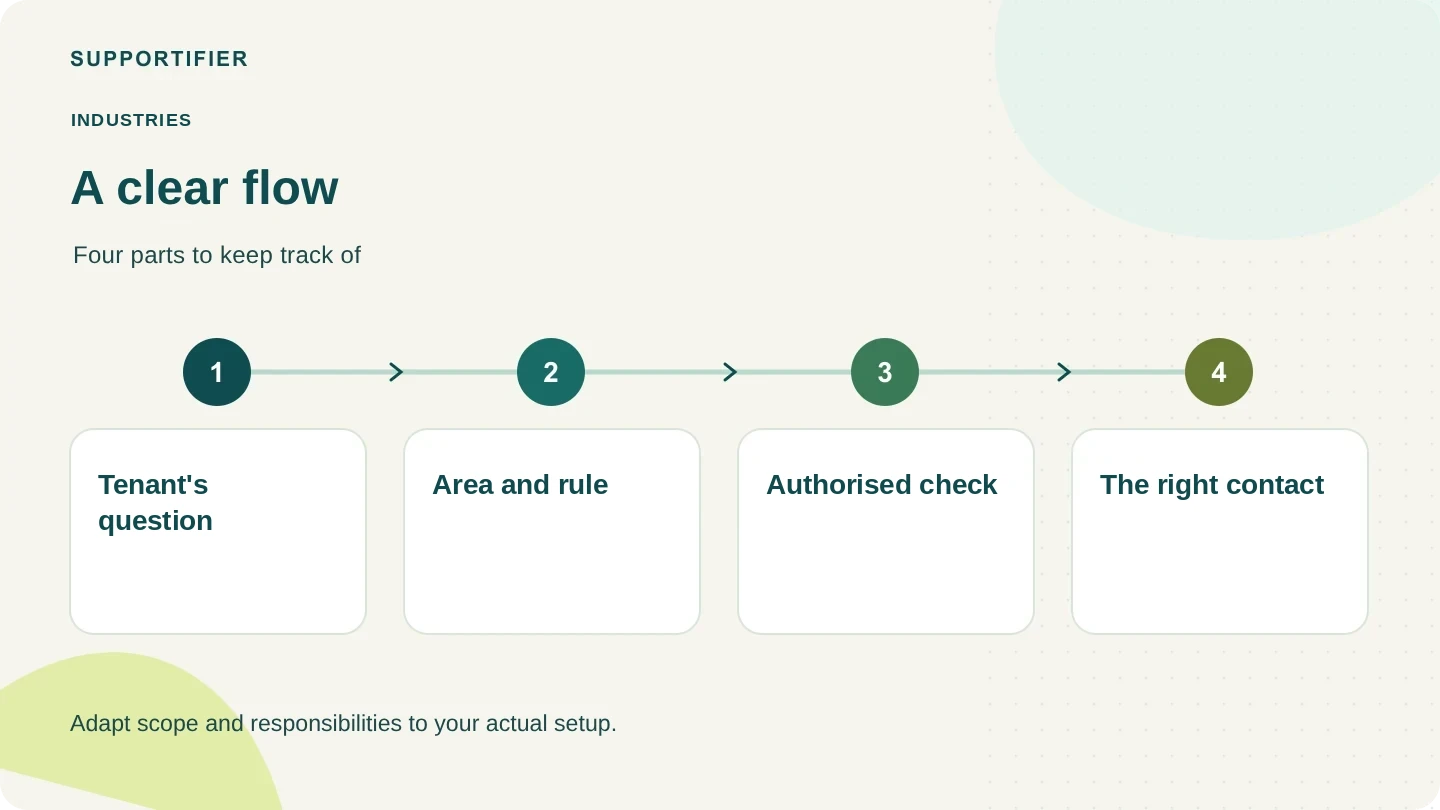
A suggested workflow. Scope and responsibilities are adapted during onboarding.
Where is the line between self-service and personal help?
The line is where the answer depends on the tenant's own contract, an open case or an assessment. AI can explain that rent reduction exists and how to request it, but not decide whether this particular tenant is entitled to it. The same applies to subletting applications and disputes that may end up at the rent tribunal.
Urgent faults are a category of their own. A chat can help find an instruction, but must not become a detour when quick contact is needed. Show your established contact routes for, say, a water leak clearly, and test that such questions lead to the right place, even when they are written in everyday words.
Customer service, property management and the on-call service need a shared view of which questions self-service may handle. A finished chat does not mean a technical fault has been fixed.
How do you keep answers right when rules differ between properties?
By making each answer state which area or property it applies to. Questions about keys, laundry rooms, parking and moving in come up often, but the instruction may sit in a PDF, on an area page or only in one employee's head. If two properties have different rules, the AI needs to know that, or ask for the address.
Also separate legal rules from the company's own routines. The notice period follows the tenancy act and the contract. How a subletting application is submitted is the company's routine. When a rule changes, you should know which articles are affected.
A practical way is to label every answer with three things: which property or area it applies to, whether it is based on law or your own routine, and who owns the text. That makes it easier to update the right answer after a renovation, a new contractor agreement or changed rules for shared spaces. It also makes it clear to the team which answers they can trust and which need checking.
How Supportifier can be used
During onboarding, existing material about living in your properties is structured into reviewed answers. Publish only information that should be available to everyone, for example in a help centre. The team can then use the same knowledge for suggested replies in the inbox when a case needs personal help.
If you need data from Vitec or another property system, the connection must be scoped separately. Vitec is not on Supportifier's published list of ready-made integrations, which you can see on the integrations page.
Track which housing questions recur, how often tenants contact you again and how many fault reports lack the information needed. Let property management review a sample of the answers.
What does Supportifier cost for a housing company? A worked example
Supportifier is priced by tickets per month, not per user. An example: a housing company gets 800 tickets a month from tenants and applicants via email, forms and phone.
| Example | Per month | Per year with yearly billing |
|---|---|---|
| Growth, 1,000 tickets per month | USD 289 | USD 3,119 |
With 800 tickets the whole volume fits in Growth, with room for a month with more fault reports. Start with 300 tickets plus overage would have cost the same, USD 289, but without the headroom.
Prices exclude VAT and are taken from the pricing page in November 2026. Every channel, every AI agent and unlimited users are included in each plan, so the price does not change when more people on the team answer. Above the plan's volume it costs USD 40 per 100 tickets started, and you can change plan at any time. The volume in the example is chosen to show the calculation, not statistics from any company; calculate with your own figures.
Common questions
Can AI take a fault report?
A form can help the tenant describe the fault, give the location and attach a photo. If the details are to create or update a fault report in the property system, that connection and the division of responsibility must be specified. Urgent faults such as a water leak must always be referred to the on-call service or property management according to your established routines.
Can AI answer questions about rent?
AI can explain general payment routines and how rent is negotiated. Personal balances, rent notices and contract details must be fetched in an authorised customer context. Questions about rent reduction in an individual case need an assessment by a person, since the right depends on the defect and when it was reported.
What should AI say about the notice period?
The answer should be based on the tenancy act and your contracts. Usually a three-month notice period applies, counted from the turn of the month after notice is given. Deviating terms, for example in fixed-term contracts, should be in the knowledge or lead on to a case officer.
Is there a ready-made Vitec connection?
No. Vitec is not on the published list of integrations. Possible access, scope and responsibility need to be investigated for your environment before such a flow can be described or promised.
Next step
Want to try it yourselves first? Start 7 days free, no card needed. Would you rather walk through a first flow with us: bring a recurring question, where the answer lives today and which systems the team uses. Book a walkthrough.
Read more
- Customer service for energy, water and city networks with AI
- Manufacturer customer service: AI support in the aftermarket
- What is a knowledge base? How it differs from an FAQ
- 7 customer service metrics you can actually act on
Sources
- Hyresgästföreningen: Uppsägningstid för hyreslägenhet
- Hyresgästföreningen: Brister och skador i lägenheten
- Hyresgästföreningen: Hyresreducering
- Hyresgästföreningen: Hyra ut lägenhet i andra hand
- Boverket: Obligatory ventilation control (OVK)
Rules and product details checked on 9 October 2026. This page is general information, not legal advice.
This page is also available in Swedish: Kundtjänst för bostadsbolag: AI som hjälper hyresgästen rätt