Industries7 min read
AI in municipal services: a chatbot that guides residents
A municipal chatbot can help residents find service information, e-services and the right contact, which supports the Administrative Procedure Act's requirement of smooth and simple contact. Start with published, reviewed information. Official matters, decisions and personal data need their own processes, and the municipality needs to assess public access to records, GDPR and Digg's guidelines before launch.
 Rickard CollanderFounder, Supportifier
- Published
- Updated
A municipality can use AI to help residents find service information, the right e-service and the right contact. Start with published and reviewed information, and leave the exercise of public authority, decisions and personal matters with the departments responsible.
Topic overview. Illustrative image, not a product interface.
What does the Administrative Procedure Act say about municipal services?
The Swedish Administrative Procedure Act requires contact with individuals to be smooth and simple. Under section 6 of the Administrative Procedure Act (2017:900), an authority must ensure that its contact with individuals is smooth and simple. Under section 7 it must be accessible and inform the public about how and when contact can be made. A chatbot can support this but does not replace the requirements.
The Act sets further requirements that affect an AI flow. Under section 9, matters must be handled as simply, quickly and cost-effectively as possible without compromising legal certainty. Under section 13, the authority must use interpreters and translate documents when needed for the individual to be able to protect their rights. So the fact that the chatbot answers in several languages does not mean the municipality's duty to provide interpretation has been met.
Which questions does a municipality get most often, and who should answer?
The table shows typical example questions in municipal services and a suitable channel. It is not statistics from any municipality, but a way to sort your own questions.
| Typical question | Channel and knowledge | Left to the department |
|---|---|---|
| When is the recycling centre open? | Help centre or chat with current information | Temporary changes without a source |
| Where do I apply for planning permission? | Link to the right e-service and short guidance | Assessment of the resident's own application |
| How do I apply for a preschool place? | Help centre with rules and deadlines | Placement and queue for the resident's own child |
| What is happening with my case? | Contact route to the case officer | Everything about the individual case |
| Am I entitled to financial assistance? | Referral to social services | Assessment and decision |
| How do I request an official document? | Help centre with routine and contact | Confidentiality assessment |
| How do I report a broken street light? | AI form with location and photo | Action by the responsible department |
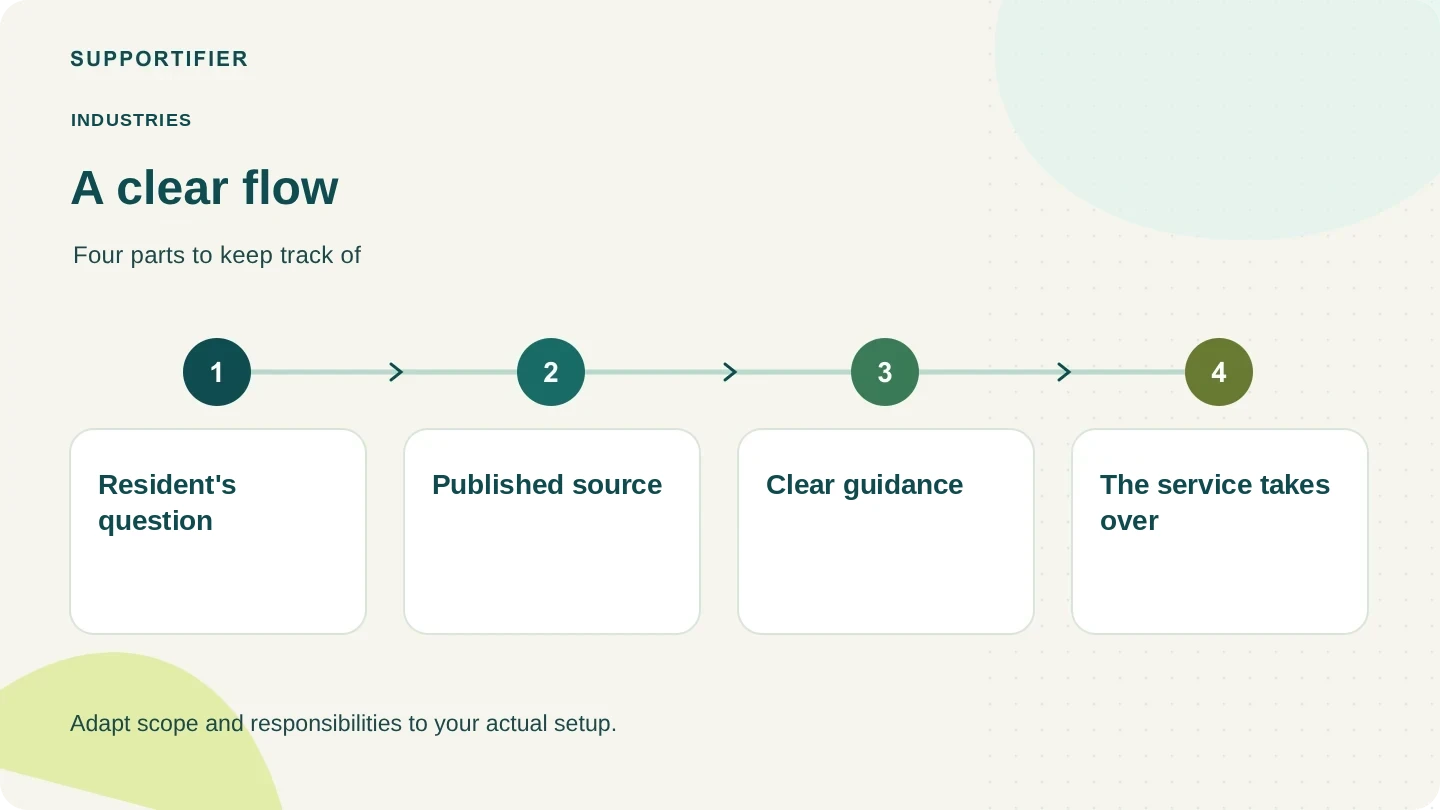
A suggested workflow. Scope and responsibilities are adapted during onboarding.
What do Digg's guidelines say about generative AI in public administration?
Digg, the Agency for Digital Government, and IMY, the Swedish Authority for Privacy Protection, published national guidelines for generative AI in public administration on 21 January 2025. They are advisory, not binding, and cover preparations such as AI policy, ethics and law, data protection, and risk and security. One heading states that decisions supported by generative AI should be subject to human control.
The guidelines are on Digg's website and also cover procurement, confidentiality, information security and preparation for the EU AI Act. In Digg's news item on the launch, IMY stresses that privacy issues need to be identified and handled early when AI is introduced. For a municipal chatbot, that means the question of personal data should be investigated before launch, not after.
How does public access to official records affect a municipal chatbot?
What residents write to the municipality can become official documents. According to the Government Offices of Sweden, a document is official if it is held by a public authority and has been received by or drawn up there. The concept of a document also covers digitally stored information.
The municipality therefore needs to decide how chat conversations and forms are kept, registered and disposed of, and how confidentiality is handled if someone writes sensitive information. That is the municipality's assessment to make, together with its registrar and archivist. A technical tool can support the routine but does not decide it.
Public access to records also affects the knowledge itself. The answers the chatbot gives are based on the municipality's own texts, and those texts should be traceable to a source and a responsible department. If a resident asks why the chatbot gave a certain answer, the municipality should be able to show which material it came from. That is one of the reasons to start with published information that has already been reviewed and has a clear owner.
How can a municipality start?
Choose one department and a clear remit. A chatbot for the library's or waste management's service information is easier to test than a general assistant for the whole municipality. The narrow scope makes it possible to find errors and decide who should correct them.
Write short answers that explain the next step, state which department the information applies to and link to the original. When two sources say different things, a responsible person needs to decide what applies. Supportifier's way of working is to build the material from existing sources and have the team review it, and the same knowledge can be used in the help centre, AI chat and inbox. Customer data is stored within the EU/EEA and is not used to train AI models, according to the security page.
An implementation in the public sector still needs to be assessed against the municipality's requirements on accessibility, information management, procurement and security. This page is a suggested use case, not a statement that every municipal flow is ready to implement.
Let people who did not write the information test it with short questions, typos and mixed-up services. Check what happens when someone writes personal data in a general question. Track the share of correct referrals and which questions lack clear information.
Common questions
Can a municipality start with a limited chatbot?
Yes, a narrow area with published service information is a possible first use case. The department still needs to assess requirements on data protection, archiving, accessibility and procurement before launch, and appoint someone responsible for keeping the answers up to date.
Should the chatbot handle personal official matters?
Not within an ordinary public FAQ flow. Matters concerning assistance, planning permission or placement require a separate assessment of process, identity, permissions and confidentiality. The chatbot can show where to apply and how to reach the case officer, but not give information about the outcome.
Do chat conversations become official documents?
They can, because received and drawn-up documents held by a public authority are official. The municipality needs to set routines for registration, retention, disposal and confidentiality before the chat is opened to residents.
Does AI replace the municipal contact centre?
No. The starting point is to make common questions and guidance easier. The Administrative Procedure Act requires the authority to be accessible for contact, so personal help needs to be available for questions that cannot be resolved through self-service.
Next step
Bring a recurring question, where the answer lives today and which systems the team uses. We go through a reasonable first flow and what needs to be reviewed. Book a walkthrough.
Read more
- AI support for schools and education: practical answers
- Chatbots that do not guess: grounded AI in customer service
- GDPR and AI in customer service: what you may do with data
Sources
- Riksdagen: Förvaltningslag (2017:900)
- Digg: Om riktlinjerna för generativ AI
- Digg: Digg och IMY släpper nationella riktlinjer för generativ AI
- Government Offices of Sweden: Offentlighetsprincipen
Rules and product information checked on 9 October 2026. This page is general information, not legal advice.
This page is also available in Swedish: AI i kommunens service: en chattbot som hjälper invånaren rätt