Industries7 min read
AI customer service for gyms and membership organisations
AI can help gyms and membership organisations with questions about booking, opening hours, cancellation, freezing and the right of withdrawal. The answers must follow consumer rules, such as a maximum 12-month commitment for gyms and a 14-day right of withdrawal for online purchases. Questions about an individual member's contract, fees or status require checking the right data.
 Rickard CollanderFounder, Supportifier
- Published
- Updated
Gyms and membership organisations can use AI to answer recurring questions about booking, opening hours, cancellation, freezing and the right of withdrawal. Answers about contracts must follow consumer rules and your terms, and questions about an individual member's contract require a check.
Topic overview. Illustrative image, not a product interface.
Which rules apply to gym memberships?
Gyms are subject to consumer rules that the Swedish Consumer Agency summarises. According to the Swedish Consumer Agency, gyms may have a commitment period of at most 12 months. Someone who signs up online has a 14-day right of withdrawal, but someone who signs up in person at the gym has no statutory right of withdrawal.
More rules that members ask about:
- Freezing. There is no statutory right to freeze the membership because of illness, injury or travel. The terms decide. If the membership is frozen, the commitment period is usually extended by the same amount.
- Price increases. During a commitment period the gym generally cannot raise the price unless the terms state a valid reason. For open-ended contracts, the gym must inform members in good time so that they can cancel.
- Closed gym. If the gym is completely closed, for example for renovation, the member should not have to pay for that period.
- Automatic renewal. According to the Swedish Consumer Agency, the renewal must be stated in the terms, and the company must remind the customer in writing at least one month before the last day to cancel. A company cannot require a particular way of cancelling, such as by phone.
The 12-month limit has been tested. In a case at the National Board for Consumer Disputes (ARN), the board found that a term with a three-year commitment period for a gym contract was unreasonable under section 36 of the Swedish Contracts Act, on the grounds that a commitment longer than 12 months creates an imbalance between the parties.
Which questions does a gym get most often, and who should answer?
The table shows typical example questions and where they can be handled. It is not statistics from any gym or organisation.
| Typical question | Channel and knowledge | Requires an extra check |
|---|---|---|
| How do I book a class? | Help centre or AI chat with the booking routine | The member's booking |
| How do I cancel my membership? | Help centre with notice period and method | The contract's commitment period and dates |
| Can I freeze my card when I am ill? | Help centre with your terms | Decision in the individual case |
| I bought the membership online, can I withdraw? | Reviewed answer on the 14-day right of withdrawal | Purchase date and channel |
| Why has the price gone up? | Help centre on price changes | The member's contract type |
| Why have I been charged a reminder fee? | General explanation of fees | Invoice and payment status |
| Which facilities are included? | Help centre per membership type | The member's membership type |
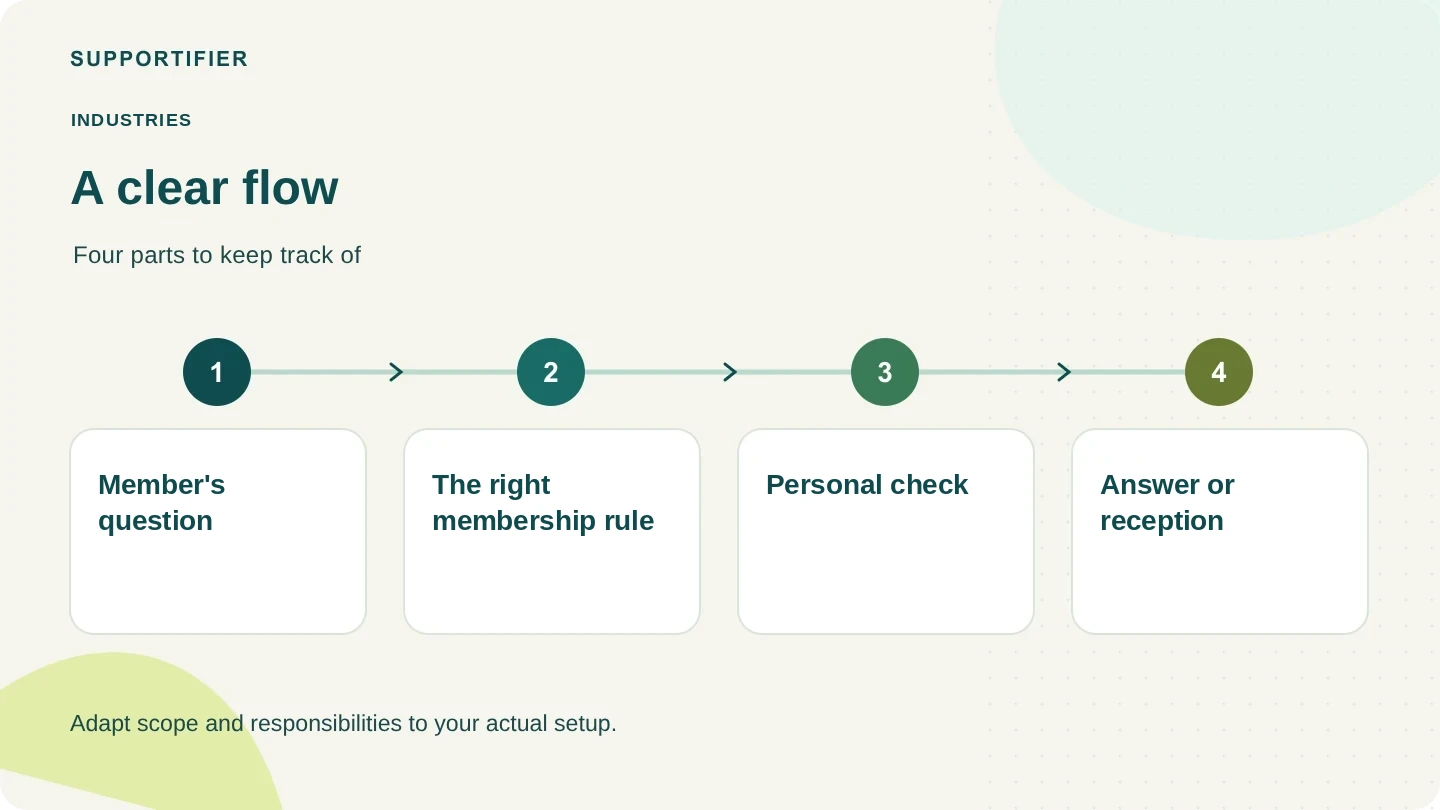
A suggested workflow. Scope and responsibilities are adapted during onboarding.
How do you calculate a notice period in an answer?
From the terms and with a concrete example. The Swedish Consumer Agency shows how it works: with a two-month notice period and a wish to end at the end of February, the member must cancel by the end of December at the latest. Someone who cancels on 15 January pays for February and March. An example like that in the knowledge makes the answer understandable.
The AI should not, however, calculate an end date for an individual member without knowing the contract. If the commitment period is still running, or if the membership has been frozen, the date changes. The answer should then lead to a check with staff or in a signed-in channel.
Do the same rules apply to membership organisations?
Not always. The rules above apply to gyms and other companies selling services to consumers. A non-profit association often has statutes that govern membership and fees. The knowledge therefore needs to state which type of membership the answer applies to and which document governs it.
Start by separating rules that apply to everyone from things that vary with membership type, facility or contract. Older campaign terms should not be used as a general rule for new members.
The same goes for timing. A member who signed up two years ago may have different terms from one who signed up last month. Mark every answer about contracts with which version of the terms it applies to and from which date. When the terms change, the old answers need to remain for existing members but not be shown to new ones. If the AI does not know which contract the member has, it should say so and refer to staff.
How can Supportifier be used?
Supportifier can structure knowledge from the website, documents and previous tickets. You review what applies, and the chosen channels then use the same foundation. A help centre can answer the booking routine, while the inbox gives the team a reviewable draft for more individual questions.
Explaining how a pause is requested is not the same as pausing a membership. If you want to read membership status, change bookings or manage contracts, the connection to your membership system needs to be scoped separately. Supportifier's integration list does not state ready-made connections to every gym and membership system.
Track recurring questions, repeat contacts and which answers the team needs to correct. If the same question often requires a new email, the routine may need clarifying rather than automating.
Common questions
Can AI end or pause a membership?
That requires a specifically approved flow with the right system connection and permissions. An answer about the routine does not mean the change has been made. The member should get a clear confirmation from you when the cancellation or pause has actually been registered.
Does the member have a right of withdrawal on a gym membership?
Yes, for 14 days if the membership was taken out online, counted from the day after the purchase. If it was taken out in person at the gym there is no statutory right of withdrawal, according to the Swedish Consumer Agency. Your own terms can be more generous.
Can different facilities have different rules?
Yes, and then the knowledge needs to state which rules apply where. If the location is unknown, the answer may need a follow-up question before the AI gives information about opening hours, booking or access.
Where does a dissatisfied member turn?
First to the gym. If the dispute remains, the member can file a complaint with ARN within a year of the first complaint. The fee is SEK 150 and, according to the Swedish Consumer Agency, handling takes around six months.
Next step
Bring a recurring question, where the answer lives today and which systems the team uses. We go through a reasonable first flow and what needs to be reviewed. Book a walkthrough.
Read more
- Customer service auto-replies: what should they say?
- Customer complaints under Swedish consumer law: what applies
- Help centre self-service: why few succeed, and the fix
Sources
- Konsumentverket: Gymkort och träningstjänster
- Konsumentverket: Automatisk avtalsförlängning
- ARN: Case summary 2018-10746 on commitment periods for gym contracts (pdf)
Rules and product information checked on 9 October 2026. This page is general information, not legal advice.
This page is also available in Swedish: AI-kundtjänst för gym och medlemsorganisationer